Reading Time: 3 minutes
Why Databook?
What are closed-loop analytics?
Read more about what sets Databook apart:
Analytics has always been part of sales. Leaders measure activity, track pipeline, and inspect forecasts to see if the numbers add up. But in many organizations, analytics is a one-way mirror: data is collected, reports are generated, and sellers keep working as usual.
Closed-loop analytics changes that. Instead of stopping at measurement, it connects insight to action—and then measures how those actions affect outcomes. The loop continuously feeds back into the system, so strategies and workflows improve over time. For go-to-market teams trying to transform seller performance, this shift is critical.
The limits of one-way measurement
Traditional analytics often provides visibility without impact. Leaders see reports filled with data, but the data rarely makes its way back into daily execution. Three limitations consistently hold organizations back:
- Focus on lagging indicators: by the time issues appear, it’s often too late to fix them. Pipeline shortfalls and missed quota are visible only after the damage is done.
- No cause and effect: leaders can see the problem but not the “why” behind it, leaving managers guessing at how to intervene.
- No behavior change: a dashboard alone doesn’t help a seller adjust strategy in the moment, so reps continue with the same motions even when they don’t work.
The result is a gap: leaders have more visibility than ever, but sellers don’t feel guided. Without a feedback loop, analytics becomes a rear-view mirror instead of a driver of future performance.
What “closed-loop” means
Closed-loop analytics is not just a buzzword—it’s a structured process that ensures insights cycle back into execution. Five elements define the loop:
- Capture—collect signals on what sellers are doing and how buyers are responding.
- Analyze—identify patterns that connect actions to outcomes.
- Guide—provide recommendations back to sellers and managers in real time, when adjustments can still change results.
- Measure—track whether the guidance was used and what impact it had on pipeline, win rates, and cycle times.
- Refine—feed results back into the system so the next cycle is smarter, creating continuous improvement.
Each step builds on the last, creating a living system that evolves with the business instead of static dashboards that quickly lose relevance.
Why closed-loop analytics matters
Closed-loop analytics matters because it links strategy with execution in a way that static reporting never can. For revenue organizations, this translates into three specific benefits:
- Behavioral visibility: leaders see whether sellers are engaging the right stakeholders, positioning the right value, and following motions that drive wins.
- Proactive coaching: instead of reacting to bad quarters, managers can intervene earlier using leading indicators and course-correct in real time.
- Continuous improvement: by reinforcing plays that work and retooling those that don’t, teams build momentum and raise the floor on performance.
Closed-loop systems close the gap between high-level strategy and the daily actions of the field. That connection is what enables lasting behavior change.
The role of AI
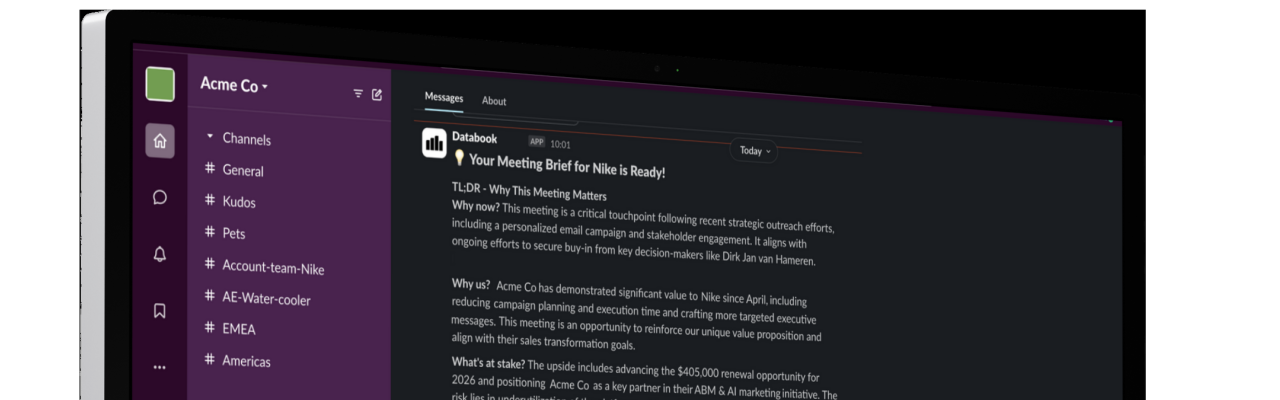
AI accelerates closed-loop analytics by processing signals at scale, delivering guidance in context, and continuously learning from results. Instead of leaders manually combing through data, AI surfaces patterns across thousands of deals and provides targeted recommendations directly in Slack, Teams, or CRM. As the system learns what works across the team, guidance becomes sharper and workflows adapt automatically. This makes analytics not just faster, but smarter—constantly improving the quality of recommendations.
Closed-loop analytics in guided selling
In guided selling, the loop ensures workflows are effective and evolve over time. For example, account planning outputs are tracked to measure whether they advanced opportunities. Territory models are tuned based on coverage and opportunity development. Coaching prompts are inspected to see if they influenced seller behavior and win rates. By tying each workflow to measurable outcomes, leaders know what’s working and where interventions are needed.
Practical examples
Closed-loop analytics provides tangible benefits at every level of the organization:
- For Sales Ops/RevOps: dashboards reveal how workflows are adopted, highlight gaps in execution, and show their direct impact on pipeline progression.
- For managers: alerts surface when executive sponsorship is missing or when a deal stalls, allowing timely coaching that targets the real issue.
- For sellers: guidance appears directly in the flow of work, reinforcing best practices through repetition and feedback. Over time, performance improves as workflows become habits.
Databook as an example
Within the GTM Control Center, leaders track workflow usage, connect guidance to outcomes, and adjust playbooks based on adoption and performance. Because reasoning and workflows are designed customer-back, feedback reflects whether sellers aligned to buyer priorities—and whether that alignment translated into results. This closes the loop not just on activity, but on value delivery, ensuring strategy and execution are always connected.
Explore more
- GTM Control Center
- Territory planning
- Pipeline progression
- Sales & revenue operations leaders
- Guided selling and the future of enterprise GTM
Conclusion
Closed-loop analytics is more than reporting. It’s a system that connects insight to action, measures what happens, and continuously refines GTM execution. Dashboards alone can’t change behavior. But when analytics is closed-loop—tied to workflows, outcomes, and feedback—it becomes the engine of transformation, helping revenue organizations improve seller performance quarter after quarter.
We'll have your first workflow running in just five days.
And we're so sure we can unlock $10m in sales productivity in your first year, we guarantee it.
We'll have your first workflow running in just five days.
And we're so sure we can unlock $10m in sales productivity in your first year, we guarantee it.